More than a body: rope bottoming matters
"What is a rope bottom?" is one of the most frequently searched terms on our website — so let's get into it.
A rope bottom (also called a rope model, or sometimes a rope bunny) is the person inside the ropes. The person doing the tying is the rigger, or rope top.
Unless you're tying a piece of furniture, rope bottoming makes up 50% of the rope equation — and it's a skill that can be cultivated in its own right. In the last decade years there's been a real and tangible shift in how rope events, classes and workshops recognise this. There's a lot more information being delivered directly to rope bottoms, an explosion of dedicated workshops, talks and resources, and it's becoming increasingly common to see prerequisites listed specifically for models attending classes.
This matters a lot to us, because Anatomie Studio was founded by a rope bottom. As a tying duo, Fred and Anna are very aware that rope is a constant back-and-forth — the rigger's rope brings out the strength in the model, and the model brings out the strength in the rigger.
How do I learn about rope bottoming?
A really good place to start is reading. If you've joined us for a Thursday Rope Jam, you'll know there are a couple of resources we recommend: Clover's Rope Bottoming Guide, The Little Guide to Getting Tied Up by Evie Vane, and Somatics for Rope Bottomsby Natasha Nawataneko. Clover's guide was the first document ever written specifically for rope bottoms — for a long time, it was the only one available. It's has been regularly updated and available in multiple languages.
These resources cover safety, body awareness, choosing partners, negotiating rope experiences and more. We recommend them equally to people who are primarily interested in tying.
We also distribute free flyers with an anatomical diagram of nerves relevant to rope — it's genuinely useful to get to know your anatomy, particularly the radial and ulnar nerves in the upper arms, since these are the ones most commonly affected.
Our Thursday Rope Jams are also a great starting point. Rope bottoming is almost always woven into the teaching — in fact, our classes are largely taught by rope bottoms who also tie.

Photo by Pixie - Inu performing at our Annual Showcase December 2025.
What is there actually to learn?
It depends! Much like tying, some people want to learn the basics so they can have a bit of safe fun, while others want to go all in. If it's bedroom fun you're after, it's probably not critical to study body management in suspension — but it's a very good idea to learn about anatomy, the different kinds of pins and needles that can come up, wrap tensioning and placement, and how to use safety shears.
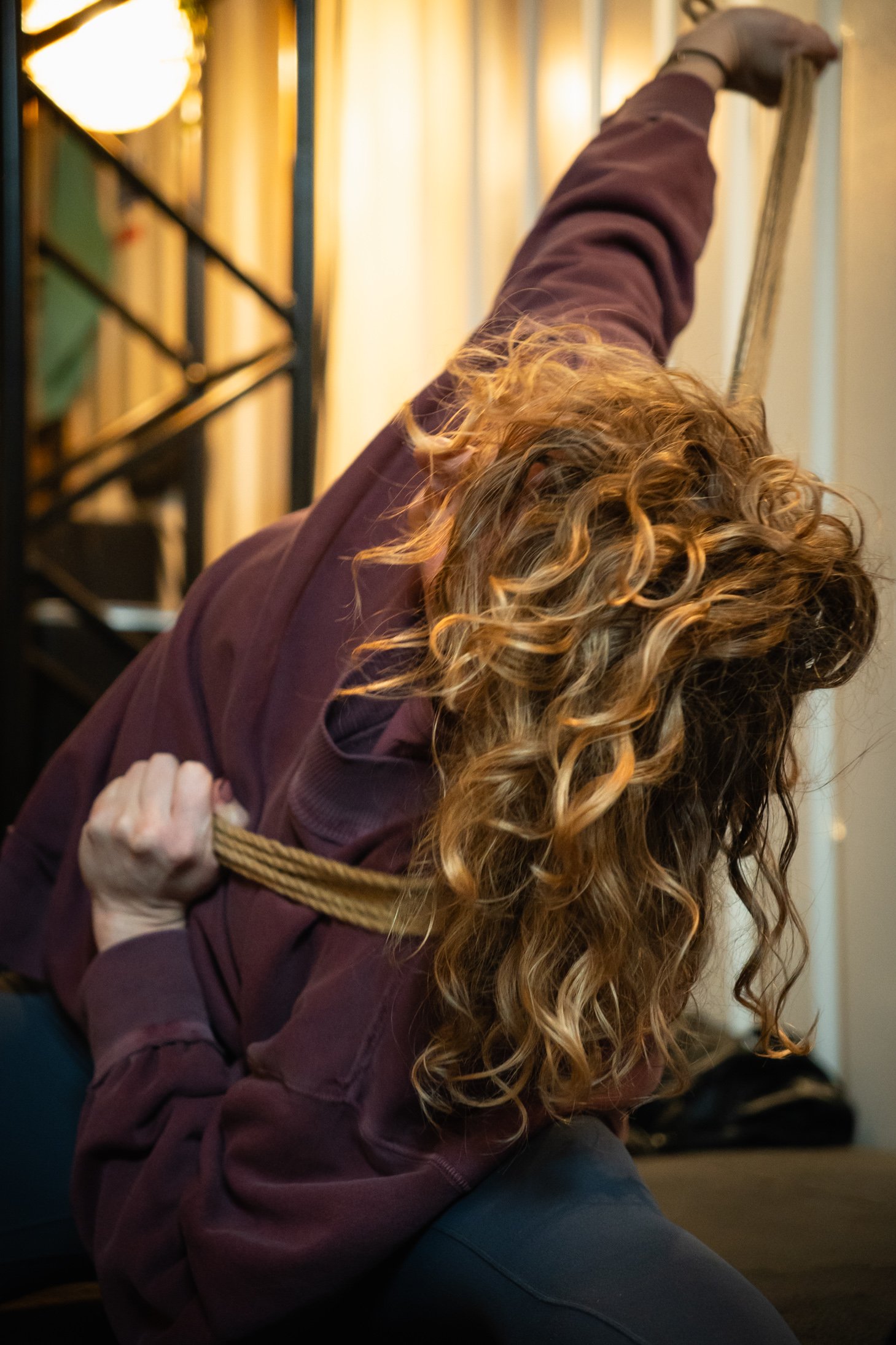
Rope bottoms who bottom professionally tend to find activities like yoga, or Pilates genuinely useful. Rope often involves the body being passively held in demanding positions, so building strength outside of rope helps protect and maintain fragile joints when you're in it.
An experienced rope bottom will also have strong body awareness and body management skills — knowing how to move inside the ropes, how to play with the balance of a tie from within it. This takes core strength (flexibility helps too, but it's not the whole picture) and a real understanding of how your own body responds. It comes with practice, which is why some of the best rope bottoms have years of experience behind them.
Rope bottoming also requires a degree of pain processing. Rope can be painful, and one of the most useful things to develop is the ability to distinguish 'good pain' from 'bad pain' — the kind you get after a vigorous workout versus the kind of sharp joint pain that's a signal to stop. Learning this takes time and a fair amount of trial and error; gradually, your body gets better at knowing when it's okay to push through a sensation and when it's time to tap out.
Which brings us to one last and perhaps most important skill: communication.
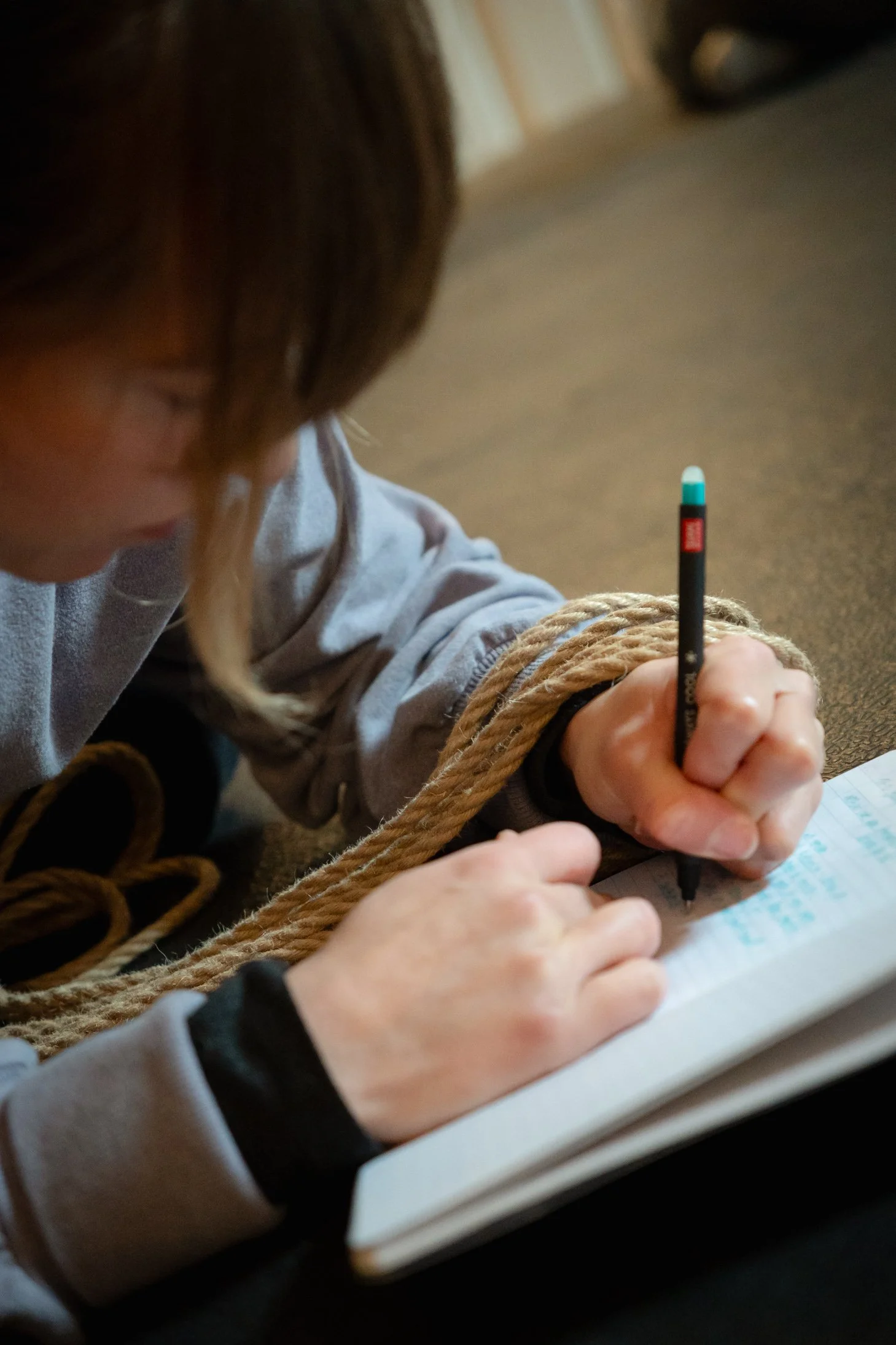
Learning to communicate effectively from inside the ropes is genuinely the heart of rope bottoming. The more specific you can be, the better — what kind of pins and needles you're feeling, whether there's a sensation you're not enjoying, whether a rope placement needs adjusting. Communication can also be non-verbal, established beforehand with your partner. It's also worth learning how to negotiate before getting into rope: what to ask the rigger, and what information is useful to share — any physical issues (a recently sprained ankle, for example), medications you're taking, sensations you do or don't want, areas of the body you're not okay having rope on. These things can change over time, or even day to day, so the conversation is always ongoing.
It's worth acknowledging that communicating effectively isn't always easy. Some rope bottoms space out and go non-verbal; others find it difficult to express discomfort — not wanting to cause offence, or not wanting the ropes to come off just yet. That's completely understandable. The important thing is to acknowledge it and have the conversation beforehand, so your partner knows what to expect.
What about the person tying me?
Just as it's hard to learn to tie without partners, it's equally hard to learn rope bottoming in isolation. Riggers are 50% of the equation too.
Both resources mentioned above — Clover's Rope Bottoming Guide and The Little Guide to Getting Tied Up — have sections on meeting and vetting potential rope partners. At the studio, we believe the safest and most enjoyable way to meet people to do rope with is to go to events and make friends. There are lots of different rope styles and different people enjoy different techniques and sensations, so watching people tie and getting to know the community is genuinely useful — and good fun.
One thing worth paying attention to when you're watching people tie: how is the rigger interacting with their model? Are they attentive? Do they move ropes when asked? Do they untie when asked? More than rope technique, this is the most important thing to notice — rope is about people, and it is fundamentally a partnership.
What are these prerequisites for workshops about?
There are no prerequisites for rope bottoms or riggers attending our beginner jams or classes — we assume zero knowledge and provide plenty of information for both sides of the rope. For more intermediate or advanced classes, we ask at minimum that rope bottoms are familiar with the differences between nerve and circulation impingement and can communicate effectively.
Beyond recognising rope bottoming as a skill, the prerequisites exist for everyone's safety. Workshops can be physically demanding and intense for both riggers and models — especially suspension-focused ones.
Here's an example of what prerequisites might look like for a non-beginner class:
Riggers: must know a solid three-rope Takate Kote, learned in a class, workshop, or private tuition.
Rope bottoms/models: must be comfortable in a Takate Kote (two or three rope), familiar with the differences between nerve and circulation impingement, and able to communicate effectively.
Why does this matter? Because in a workshop environment, a rigger's attention is split — they're focusing on a new technique, listening to the teacher, and staying aware of others around them. They're relying heavily on model feedback. An inexperienced model who doesn't know their body well may not recognise or communicate what they're feeling, and this is exactly when small nerve injuries can happen. In the few instances we've seen this at the studio, the rope bottoms involved simply hadn't yet learned to identify what they were experiencing.
Do I have to be super fit and bendy?
Nope. Rope is a wonderfully diverse activity enjoyed by adults of all ages, body types, backgrounds, genders and sexes.
Like any physical activity, it's about finding the kind of rope you enjoy and the partners who want to do that with you. Different bodies, different flexibility, different pain thresholds — the diversity is genuinely the point.
It's also worth noting that while most shibari imagery online tends to feature petite, young, flexible women tied by men, this is not the reality of what you'll encounter at a local rope event. There are plenty of male-identified people who love being in rope, and plenty of female-identified people who love to tie. If binaries aren't really your thing, there's a lot of gender queerness in the rope world too. In short: it's considerably more varied than a Google image search for 'shibari' might suggest.
Have questions about rope bottoming, or want to come and experience it for yourself? Our Thursday Rope Jams are a great place to start — find upcoming events on our events page.Somat
