What's in a name? The strange, raunchy history of the word "bunny"
If you've spent any time around rope communities, you'll have heard the term. Rope bunny. Said with affection, sometimes with a slight eye-roll, occasionally with real objection. Some people love it as a self-identifier; others find it reductive and reach for rope bottom or rope model instead.
Almost nobody stops to ask where it actually came from. Or why we landed on bunny specifically, and not some other small soft animal.
Turns out the word has a genuinely weird history. One that runs right through sexuality, euphemism, and who gets to name whom.
The word "bunny" did not originally mean rabbit
This surprises people. The Online Etymology Dictionary records the word bun as a term of endearment for a young woman or child from around 1600, with bunny emerging shortly after — and its first appearance as a pet name for a rabbit from the 1680s, roughly a century later.
It derives from bun, a Scottish dialect word used for both squirrels and rabbits from the 1580s onwards. The deeper roots are disputed: it may trace back to Scottish bun meaning "tail of a hare," or to the French bon, or to a Scandinavian source. The etymology remains uncertain. What's clear is the direction of travel: term of endearment first, animal second. The rabbit borrowed the name from that register of warmth and smallness, not the other way around.
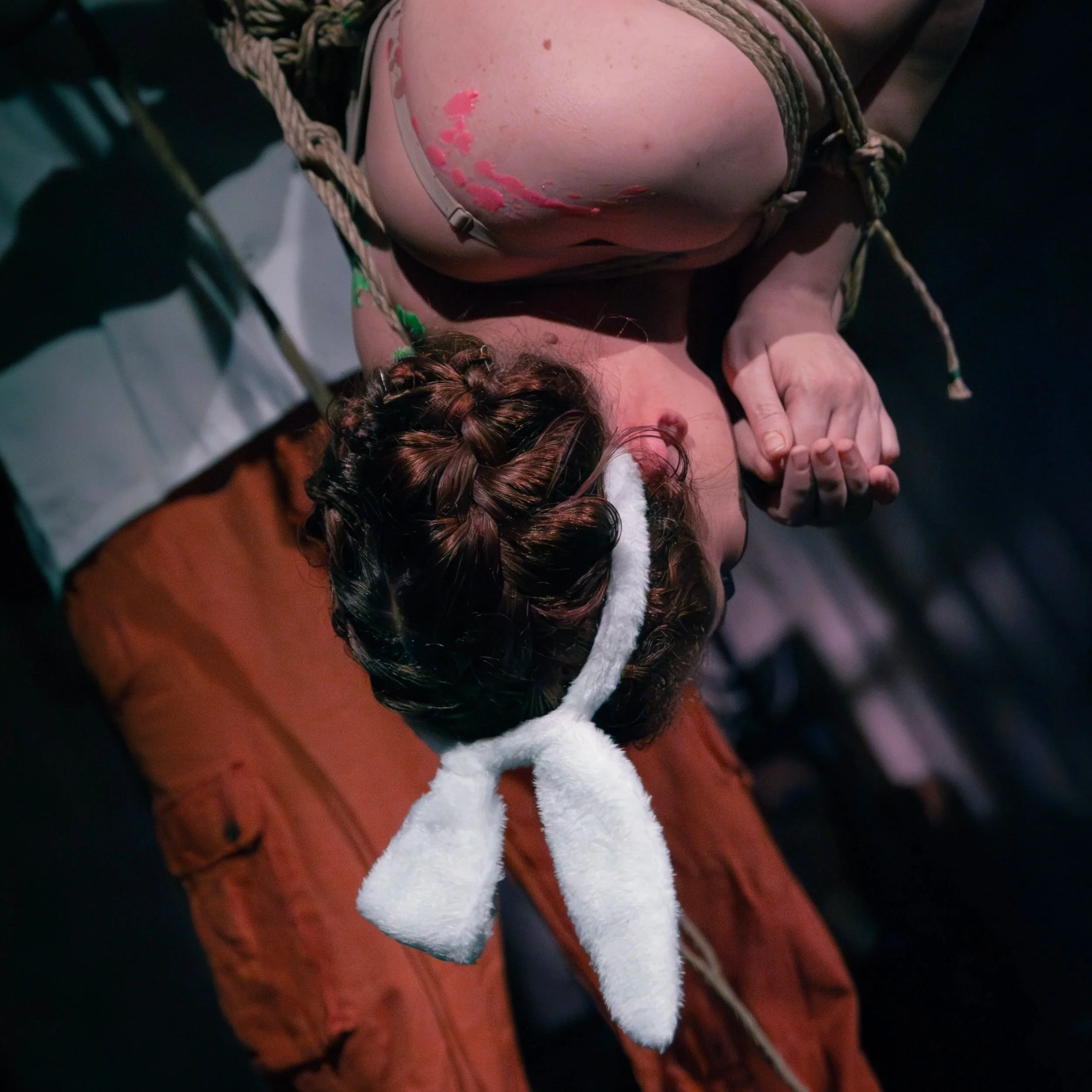
Latex Dancer tied by Rory Ropes during our Showcase in December 2024. Photo by Pixie.
Meanwhile, there was a much older word for rabbit, and it was getting awkward
Before bunny took hold, the standard English word for the adult animal was coney — from Old French conil, from Latin cuniculus. Coney was pronounced to rhyme with honey and money. Which, by the late 1500s, was also slang for the female genitalia.
Marlowe used it. Shakespeare punned on it. Eventually the phonetic problem became too much. The Online Etymology Dictionary notes that rabbit displaced coney "after British slang picked up coney as a punning synonym for cunny." So English effectively needed a polite word for this animal twice. First coney got too dirty, so rabbit stepped in. And bunny, already carrying its register of softness, emerged alongside it as the gentler option.
In sum… every time English speakers have needed a word for this animal, they've reached for something warm and diminutive. And those words keep ending up adjacent to sexuality anyway.
The rabbit has always meant something sexual
In the ancient Greco-Roman world, the hare symbolised fertility, love, and lust. It was a favoured offering to Aphrodite and Eros, and the animal's body was incorporated into medicines connected with sex. The classical world also exaggerated the creature's capacity for reproduction considerably: Aristotle described the hare as capable of superfetation (becoming pregnant again while already pregnant) in his History of Animals (Book VI).
The hare served as a gift between lovers in antiquity. Renaissance painters folded all of this in too — Titian's Madonna of the Rabbit (c.1530), now in the Louvre, shows the Virgin holding a white rabbit. Drawing on the ancient belief that hares could conceive without losing virginity, the animal was read by contemporaries as a sign of Mary's purity and the miracle of the Incarnation.
Throughout Western culture, the rabbit's symbolic profile is a consistent tangle of fertility, vulnerability, innocence, and sexuality, often at the same time. The juxtaposition isn't incidental, it's the entire point.
Hefner knew exactly what he was doing
When Hugh Hefner chose a rabbit as the Playboy logo in 1953, he was deliberately tapping that existing charge. In a 1967 interview with journalist Oriana Fallaci, he explained it plainly:
"The rabbit, the bunny, in America has a sexual meaning; and I chose it because it's a fresh animal, shy, vivacious, jumping, sexy. First it smells you then it escapes, then it comes back, and you feel like caressing it, playing with it. A girl resembles a bunny."
He's describing a specific kind of sexuality: playful, somewhat elusive, approachable. Not threatening. He explicitly contrasted it with the sophistication and darkness of the femme fatale. The bunny was the alternative: fresh, simple, available within the game's rules.
To be clear, Hefner was a predator, as the testimony of former Playmates, Bunnies, and girlfriends has now thoroughly documented. The Fallaci quote isn't interesting despite that record, but because of it. He is telling us, in his own words, exactly what kind of woman the Playboy brand was designed to produce.
The Playboy Bunny officially debuted at the opening of the Chicago Playboy Club on February 29, 1960, and the costume became the first service uniform registered by the United States Patent and Trademark Office.
This branding of ‘bunny’ as a type of femininity that's soft, playful, designed to be looked at, lodged itself in the cultural unconscious as English-speaking BDSM communities were beginning to form and name themselves.
So when did "rope bunny" actually enter the BDSM lexicon?
We don't actually know so we can only guess.
What we do know is that the earliest Urban Dictionary entry is from 2016. The Wiktionary entry notes plainly that its etymology "is incomplete."
What we can say is that the term almost certainly came out of English-language online BDSM communities (forums, mailing lists, early fetish sites) in the late 1990s or early 2000s, running alongside the Western uptake of rope bondage and shibari.
Bunny was already circulating in adjacent spaces: pet play communities, D/s dynamics as a general term of affection. So it arrived from several directions at once and nobody wrote down the moment it landed.
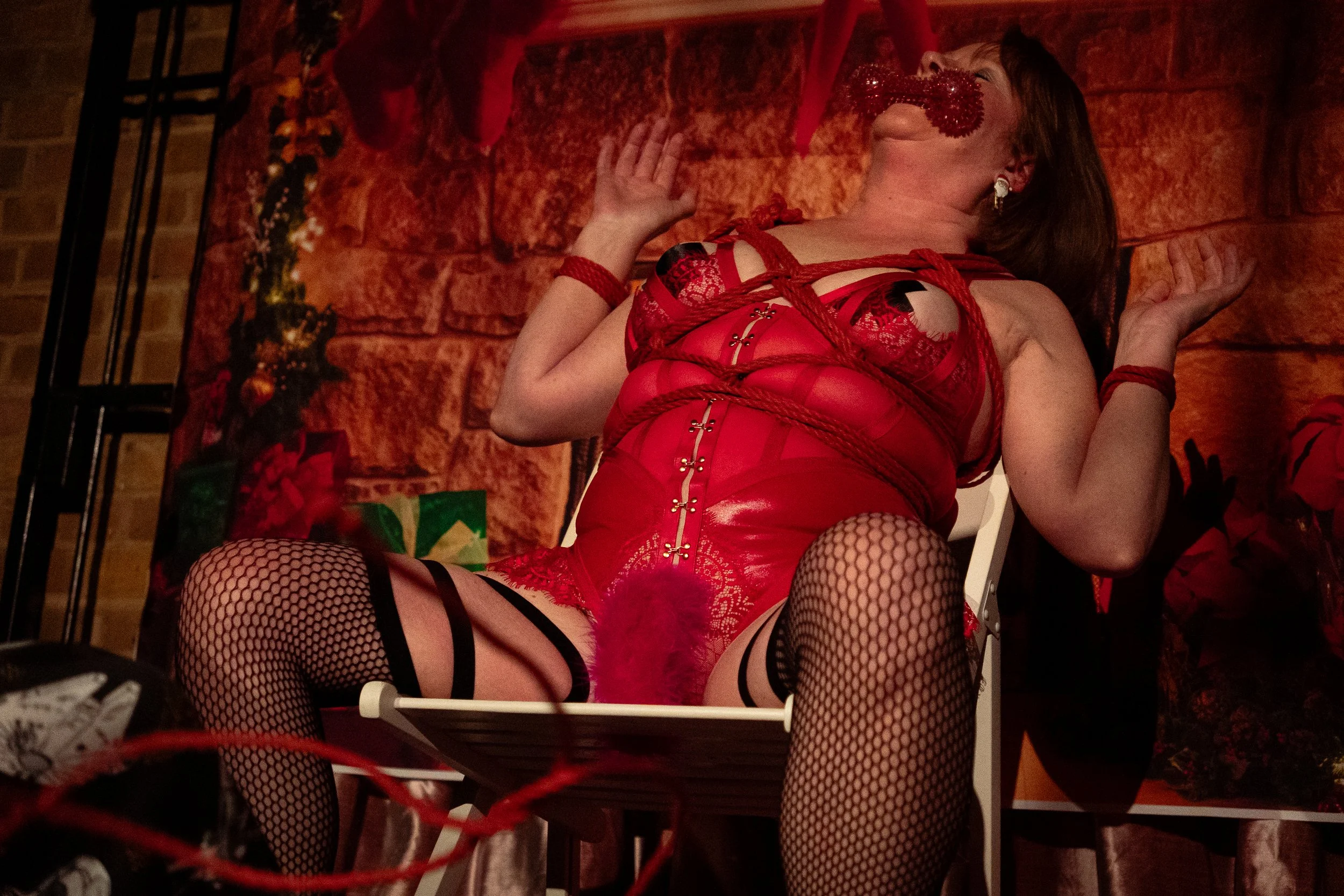
From Shaun and Lynn’s playful performance during the showcase December 2025. Photo by Pixie.
Why "bunny" doesn't sit right with everyone
Not everyone in rope communities uses the term, and the objections tend to cluster around what the word implies about the person being tied.
Bottoming in rope is a skilled, active role, it requires physical endurance, body awareness, and real-time communication. The word bunny doesn't carry any of that. It carries softness, smallness, a certain wide-eyed passivity. The concern, reasonably, is that it casts the bound partner as a passive recipient rather than an active participant in a scene. Rope bottom sidesteps this because it describes a role without implying anything about the person's character or capacity. Rope model also does that, emphasising the collaborative, skill-based dimension of the work.
None of this means the term is wrong or that people who use it affectionately are doing something harmful. Language doesn't work that way. But it does explain why thoughtful people in rope communities reach for different words, and why the debate keeps surfacing.
Today there's a wider lexicon to choose from, and plenty of people happily self-describe as rope bunnies. That's how it should be. What grates isn't the word — it's being called a rope bunny by someone who hasn't bothered to ask. The assumption is definitely an “ick” for most rope bottoms.
So the next time you hear the term, or reach for it yourself, it's worth remembering what it's carrying. Four hundred years of endearments for women, a displaced euphemism, a Playboy logo chosen for its "sexual meaning", and a rope communities still working out which of its inherited words actually fit.
Sources
Etymology of bunny and coney: Online Etymology Dictionary (etymonline.com); World Wide Words; Wiktionary.
Rabbit symbolism in antiquity: University of Notre Dame Medieval Studies Research Blog (Dr. Emily McLemore, 2024); Wikipedia, "Rabbits and Hares in Art."
Aristotle on superfetation in hares:History of Animals, Book VI, Chapter XXXIII (Loeb Classical Library edition).
Titian's Madonna of the Rabbit: Wikipedia; Louvre collection notes.
Etymology of bunny and coney: Online Etymology Dictionary (etymonline.com); World Wide Words; Wiktionary.
Rabbit symbolism in antiquity: University of Notre Dame Medieval Studies Research Blog (Dr. Emily McLemore, 2024); Wikipedia, "Rabbits and Hares in Art."
Aristotle on superfetation in hares: History of Animals, Book VI, Chapter XXXIII (Loeb Classical Library edition).
Marlowe's pun on cony: Ovid's Elegies (translation of the Amores), Book 1, Elegy 10: "The whore stands to be bought for each mans mony, / And seekes vild wealth by selling of her Cony." Published posthumously c.1599–1603 and publicly burned in the Bishops' Ban of 1599. Text via Early English Books Online (University of Michigan Library).
Shakespeare's pun on cony: As You Like It, Act 3, Scene 2 (lines 329–30, Folger edition): Rosalind, disguised as Ganymede, to Orlando: "I am… as native [here] as the cony that you see dwell where she is kindled."